> ## Documentation Index
> Fetch the complete documentation index at: https://docs.clinia.com/llms.txt
> Use this file to discover all available pages before exploring further.
# What is Master Data Management?
> Overview of Clinia’s MDM module for unified collections, entity resolution and queues
export const WorkInProgress = ({children}) => {
const workInProgressSvg = ;
return
{children}
;
};
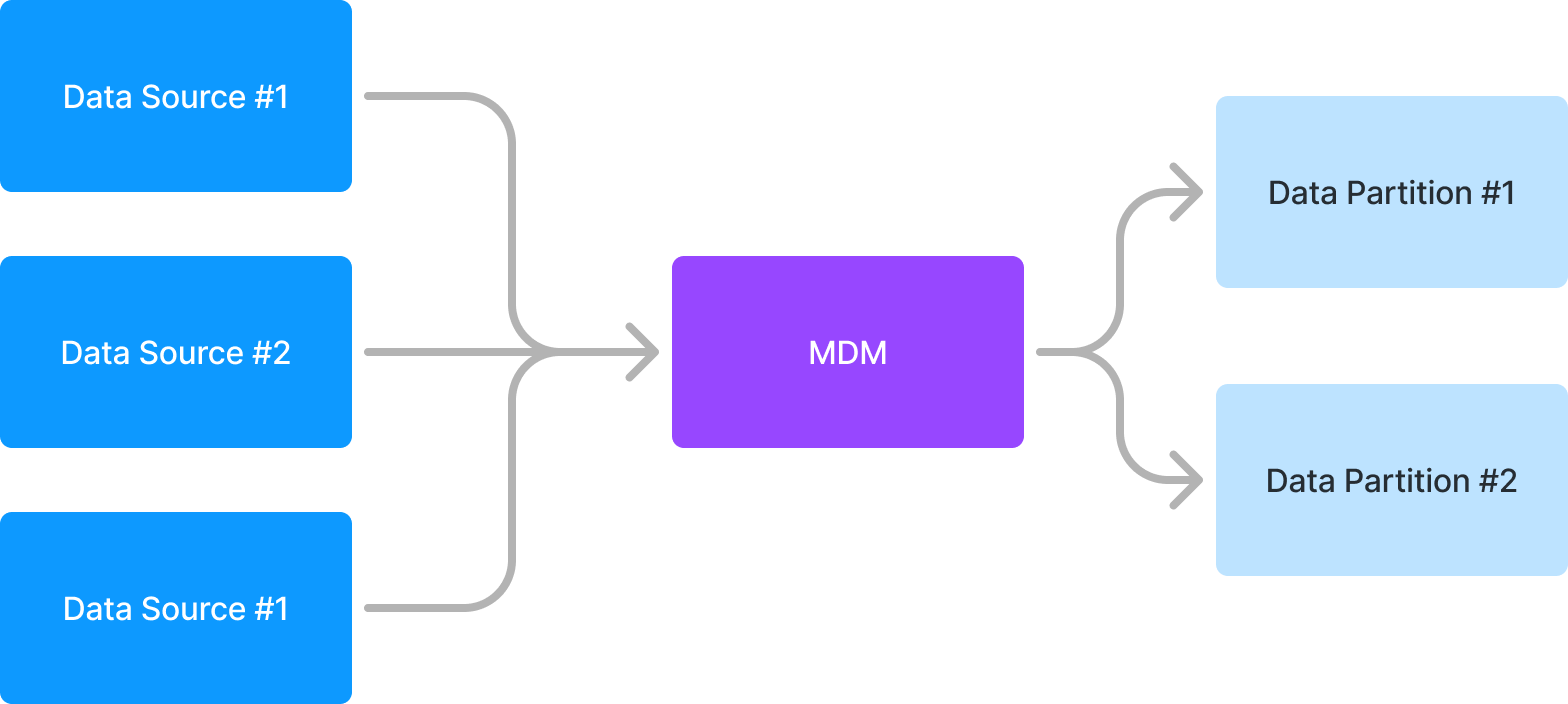
In the healthcare ecosystem, Master Data Management (MDM) is the discipline of centrally managing an organization's critical data—such as provider, patient, medical, or academic information—to ensure consistency, accuracy, and reliability across the entire organization.
MDM integrates this core data across various systems, using governance and data quality processes to create a single, authoritative source of truth. This supports better decision-making, operational efficiency, and compliance.
The Clinia Platform's MDM module enables users to configure and implement data structures and processes following enterprise-grade MDM best practices to ensure their organization gets trusted data whenever it needs it.
## Collections
The `Collection` concept is still evolving. It will ultimately supersede the current profile container and become the single place that gathers:
* The schema (what was previously known as the profile)
* Associated ingestion pipelines
* Search configuration
* The curated dataset produced by entity resolution
Collections give MDM its backbone: they aggregate resolved entities across sources, apply reconciliation policies, and expose a stable contract for downstream partitions. Treat them as the canonical master records that other systems depend on.
# Unified Collections & Unified Relationships
Unified collections are tools for aggregating and unifying fragmented data from multiple data sources into a single unified resource type. Similarly, Unified Relationships' primary purpose is to unify relationships across different sources, between different entities under a singular, unified relationship type.
# Entity Resolution
[Entity Resolution](/explanation/mdm/entity-resolution/overview) is a technique for identifying data records in a single or across multiple data sources that refer to the same real-world entity and linking them together.
# Queue Module
The Queue Module allows Data Stewards to participate in system and user-defined data quality processes. It puts humans at the center of otherwise heavily automated decision-making processes.
User-defined triggers and system events create review items placed in various queues. Data Stewards can review items and resolve pending issues using dedicated user interfaces.