

From Theory to Practice
Which graph types, VFS paths and REST operations sit behind Recorded Memory and Learned Memory.
Recorded Memory and Learned Memory are high-level concepts that describe the content of a patient graph, but they are not concrete API objects you interact with when using the Context Engine. The API returns facts, narratives, memories and the edges between them.
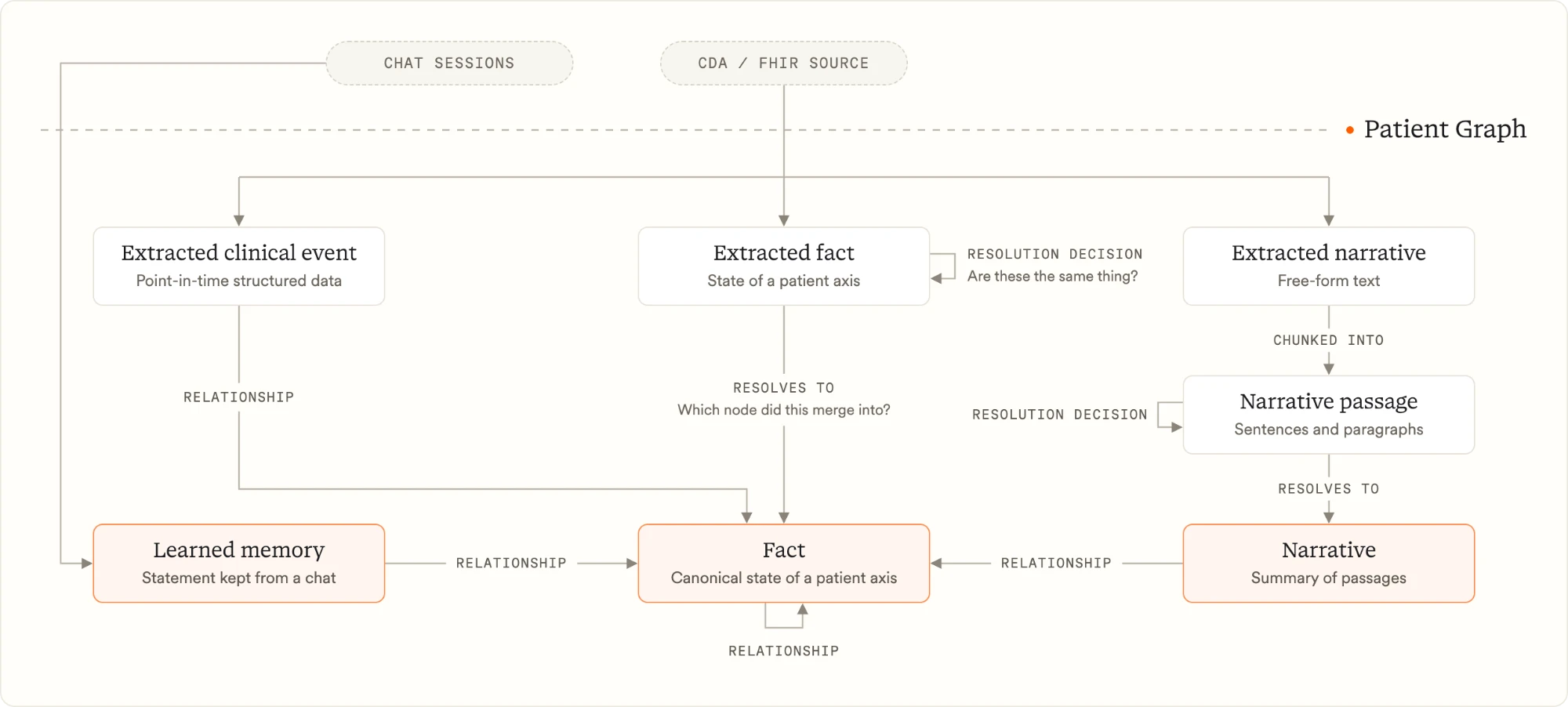
Four families of REST operations touch these objects.
| Family | Operations | What it returns |
|---|---|---|
| Graph | list-nodes, get-node, list-edges, get-edge and one query operation per node and edge type, shown as Query nodes and Query edges (technical preview) | The nodes and edges themselves |
| VFS | browse-vfs and read-vfs | Folders and files rendered from the graph |
| Sessions | get-session and list-session-memories | A session's metadata and its memories |
| Ingestion | ingest-fhir-r4, ingest-fhir-r5, ingest-cda-r2, ingest-sessions, list-ingestions and get-ingestion | Receipts that track a submission and none of the objects it produces |
Recorded Memory objects
Six node types make up Recorded Memory.
| Object | What it is | VFS paths | REST operations |
|---|---|---|---|
extracted_fact | The state of a patient, as one source stated it | None | Graph operations, including query-extracted-fact-nodes |
extracted_clinical_event | A point-in-time event such as an encounter, an observation, a procedure or an administered dose | /timeline/ | Graph operations, including query-extracted-clinical-event-nodes |
extracted_narrative | The free-form text of a document | /sources/ | Graph operations, including query-extracted-narrative-nodes |
narrative_passage | A sentence or paragraph of an extracted narrative | None | Graph operations, including query-narrative-passage-nodes |
fact | The canonical state of a patient axis, merged from the extracted facts that describe it | The entity folders: /conditions/, /medications/, /labs/, /allergies/, /encounters/, /directives/, /insurance/, /family_history/ and /social_history/ | Graph operations, including query-fact-nodes, and read-vfs with structured format |
narrative | A summary of narrative passages | /conditions/{status}/{slug}/_narratives/ | Graph operations, including query-narrative-nodes |
Four edge types record how the nodes were formed and what relates to them.
| Object | Runs between | What it records | VFS paths | REST operations |
|---|---|---|---|---|
resolves_to | An extracted fact and its fact, and a narrative passage and its narrative | Which canonical node an extracted node was merged into | None | Graph operations, including query-resolves-to-edges |
resolution_decision | Two nodes of the same type that the engine compared | The verdict (merge or reject), the rule that fired and the evidence | None | Graph operations, including query-resolution-decision-edges |
chunked_into | An extracted narrative and its narrative passages | How a text was split into passages | None | Graph operations, including query-chunked-into-edges |
relationship | A fact and a fact, a narrative and a fact, and a learned memory and a fact | A typed link, either a clinical link between facts or corroborates, enriches or conflicts for a narrative or a memory | A condition's _story.md and _narratives/, and the typed edges returned by read-vfs with structured format | Graph operations, including query-relationship-edges |
The audit surfaces start with the graph operations
No VFS path shows a resolution edge, so tracing a fact back to its sources or reading why two nodes merged is done with the graph operations. Audit the Patient Graph walks through both.
Learned Memory objects
Three objects make up Learned Memory. Only the memory is a node in the patient graph.
| Object | What it is | VFS paths | REST operations |
|---|---|---|---|
| Session | One conversation with a patient, created by its first write | None | get-session and ingest-sessions (technical preview), while create-session and upsert-session are deprecated |
| Message | One turn of a session | None | No operation returns messages, while append-messages is deprecated in favour of ingest-sessions |
learned_memory | A statement kept from a session, of type symptom, adherence, concern or preference, stored as a short text passage | /memory/{type}.md, plus the Patient-Reported section of a condition story and of a medication file | Graph operations, including query-learned-memory-nodes, and list-session-memories |
A memory links back to a fact through the relationship edge described in Recorded Memory objects. The link follows three rules.
- Only
symptommemories, which link to conditions, andadherencememories, which link to medications, are linked to facts.concernandpreferencememories stay unlinked. - The link is typed
corroborates,enrichesorconflicts, depending on whether the memory agrees with the fact, adds context to it or contradicts it. - The link leaves the fact as it was. Memories are never merged or updated.
How the Engine Thinks About Data
How the engine forms memory and assembles context, and how it weighs each piece of information based on scope and attribution.
Provision Your First Workspace
Sign up for the Clinia Console, create an organization and a sandbox workspace, and get a credential your application can call the Context Engine with.